I. Genesis Neighbourhood Scale: Breka Transformation within the Bauhaus4MED Project
The transformation of the Breka neighbourhood in Sarajevo represents a visible impolementation of how the principles of the New European Bauhaus (NEB) – sustainability, inclusion, and beauty, can take shape in a local community through a participatory design process. Initiated in 2024 within the framework of the Interreg EuroMED project Bauhaus4MED, and implemented by the City of Sarajevo in cooperation with the Association of Landscape Architects in Bosnia and Herzegovina (APAuBiH) and the Municipality of Centar, this initiative aimed to turn a neglected urban site into a vibrant, community-driven public space that reflects the values of the citizens of Sarajevo and its European aspirations
From its inception, the Breka process was designed as an open and inclusive model of urban regeneration, combining professional expertise with citizen participation. The first phase focused on identifying underused or degraded spaces within the city that could serve as pilots for participatory transformation. A local advisory group, composed of city representatives, architects, and community stakeholders, selected a location between Hasana Sušića, Ismeta Mujezinovića, and Jovana Bijelića streets. It is a forgotten piece of land that still held symbolic importance for residents due to its central position within a densely inhabited neighbourhood.
The project came up in a broader context of Sarajevo’s green and digital transition, marking a shift in how the city conceives urban restoration – not as a purely technical intervention, but as a social and cultural process, involving all stakeholders. As one of Sarajevo’s first NEB pilot sites, Breka became a laboratory for co-design, testing methods for citizen engagement, participatory voting, and collaborative planning that could later be scaled to other neighbourhoods.
Its roots also lie in Sarajevo’s growing commitment to European urban innovation networks, including the EU Mission for 100 Climate-Neutral and Smart Cities, which emphasize citizen participation as a driver of climate and social resilience. That is why the Breka case symbolizes Sarajevo’s entrance into a new era of urban policies development, where spatial design becomes a the path for environmental awareness, civic inclusion, and European integration.
The timing of the project also carried symbolic value for Sarajevo. In April 2025, Sarajevo hosted the NEB Festival and Bauhaus4MED partner meeting, bringing together designers, academics, and policymakers from across the Mediterranean region. The Breka transformation was publicly introduced during this event through an on-site participatory workshop, an exhibition of European NEB examples, and an artistic performance of traditional music, linking Sarajevo’s cultural identity with its future-oriented urban vision.
In addition to physical transformation, the Breka project idea shows a deeper policy change: an understanding that Sarajevo’s neglected urban spaces can become platforms for community resilience and shared maintenance. By inviting citizens to co-design their environment, the city improves public space and strengthens local democracy and the sense of belonging essential foundations for a sustainable urban future at the same time.
II. Triggers Neighbourhood Scale: Breka Transformation within the Bauhaus4MED Project
The transformation of the Breka neighbourhood was motivated by a combination of environmental degradation, spatial neglect, and social fragmentation that had added up over decades of uncoordinated urban growth in Sarajevo. These challenges, common to many post-socialist cities, became especially visible in Breka – a residential area characterized by steep topography, aging infrastructure, and limited access to quality public spaces. The decision to focus the Bauhaus4MED pilot on Breka was then both a practical and symbolic act: to demonstrate how a small-scale, citizen-led intervention can speed up wider change in urban culture and gonverning.
Environmental and Spatial Challenges
The chosen pilot site in Breka neighbourhood of Sarajevo is a small, underused area surrounded by residential buildings and local shops that had long suffered from neglect. It was largely devoid of greenery, with uneven terrain, deteriorated surfaces, and no coherent landscaping. Rainwater drainage was poor, causing occasional pooling and soil erosion, while heat accumulation during summer months made the space uncomfortable and unwelcoming. These micro-environmental problems reflected larger urban issues facing Sarajevo: loss of green cover and declining biodiversity in densely populated neighbourhoods.
The absence of vegetation or sustainable design elements not only affected the ecological value of the site, but also contributed to its perception as an unsafe, unattractive, and forgotten corner of the local community. Revitalizing such spaces became an environmental necessity, as neighbourhood-level green areas are critical for urban cooling, carbon absorption, and community well-being, which are key priorities under the New European Bauhaus and EU Green Deal frameworks.
Infrastructure and Mobility Limitations
At the infrastructural level, Breka’s public spaces have historically been disconnected. The site lacked basic urban furniture, lighting, and accessible paths connecting it to surrounding streets such as Hasana Sušića and Jovana Bijelića. For elderly residents, children, and people with mobility challenges, this created physical barriers that limited the space’s usability. The area’s lack of lighting further reinforced perceptions of insecurity and discouraged social activity after dark.
Sarajevo’s mountainous topography and compact street network emphasize these infrastructural problems: small open areas like the one in Breka often serve multiple functions – they can be used as pedestrian shortcuts, informal gathering spots, or non-regulated parking areas, and they rarely receive structured investment or maintenance. That is why the project aimed to show how sustainable landscape design could enhance both safety and accessibility, integrating Breka local spatial layout into the city’s wider mobility and environmental strategies.
Social and Cultural Triggers
The social motivation for transforming Breka came from from an existing sense of disconnection between residents and their urban environment. Many citizens expressed frustration over neglected spaces and the lack of opportunities to influence how their neighbourhoods evolve. The participatory workshop held in May 2025, led by the Association of Landscape Architects in Bosnia and Herzegovina (APAuBiH), revealed a strong desire for change within the community. Residents called for more greenery, playgrounds, lighting, and communal gathering areas where children and families could meet safely.
This demand reflected a deeper social need to restore community life in the aftermath of years of limited civic engagement and uneven post-war urban development. The Breka site offered an ideal testing ground for re-establishing this relationship between citizens and local authorities through a structured, transparent, and creative process.
The initiative coincided with the City of Sarajevo’s ambition to embed participatory design methods within its broader sustainable development agenda. The Decidim Sarajevo digital platform, introduced previously under different initatives provided a ready infrastructure for citizen voting and dialogue, allowing residents to co-decide the outcome of the design competition. The integration of both physical and digital participation marked a new chapter in the city’s governance culture.
European and Policy-Level Triggers
The Breka pilot also responded to the European call for experimentation under the Bauhaus4MED project, which aims to translate the values of the New European Bauhaus into real-world interventions across Mediterranean cities. For Sarajevo, participating in this programme was an opportunity to demonstrate alignment with EU sustainability standards, while showcasing how small-scale, community-driven transformations can support the city’s commitments under the Climate City Contract and the NetZeroCities Mission.
Finally, Breka’s selection was motivated by a political and cultural trigger: the recognition that beauty and belonging are not luxuries but preconditions for social sustainability. By turning an overlooked lot into a shared public space, the project looked to prove that design can be a form of reconciliation between citizens and institutions, between nature and urban life, and between Sarajevo’s heritage and its European future.
III. Transformational Context Neighbourhood Scale: Breka Transformation within Bauhaus4MED
The Breka Transformation emerged from Sarajevo’s recognition that neglected public spaces are not just places with lack of aesthetic draw, but lost opportunities for social connection, environmental resilience, and participatory governance. The process was conceived as a living laboratory for testing the principles of the New European Bauhaus (NEB) sustainability, inclusion, and beauty at the scale of an ordinary neighbourhood. Within the broader Bauhaus4MED project, financed by Interreg EuroMED, Sarajevo’s pilot became both a design experiment and a statement of intent: to reimagine the relationship between citizens and the spaces they inhabit
From Neglect to Co-Design
The transformational approach in Breka was based in the understanding that effective regeneration of a community cannot be imposed by force, it must be co-produced. Following the selection of the site between Hasana Sušića, Ismeta Mujezinovića, and Jovana Bijelića streets, the City of Sarajevo, together with the Association of Landscape Architects of Bosnia and Herzegovina (APAuBiH) and the Municipality of Centar, initiated an extensive participatory process.
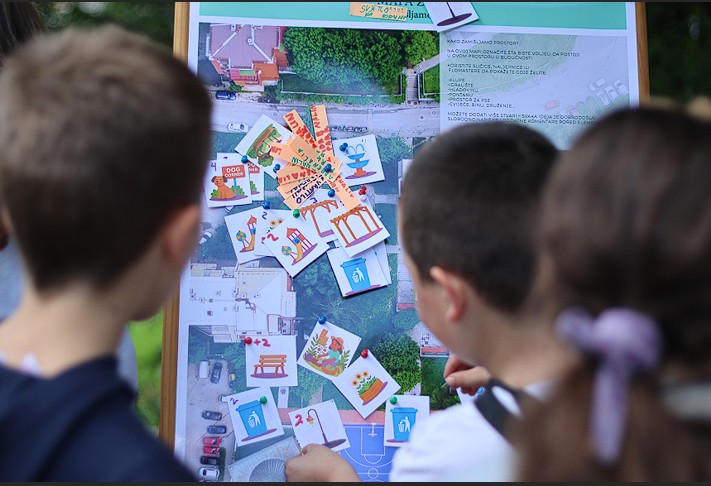
The first milestone took place in May 2025, when local residents were invited to participate in an on-site participatory planning workshop. Led by APAuBiH experts, this session blended professional urban analysis with community storytelling, mapping, and direct feedback collection. Citizens were encouraged to articulate how they experience the space, what functions they miss, and how it could better serve needs of different generations, from children’s play areas and lighting to greenery, benches, and pathways.
This inclusive dialogue generated a strong agreement: the space should be green, open, and welcoming, reflecting a sense of belonging. These insights became the conceptual foundation for the next stage – an open architectural and landscape design competition.
Hybrid Design and Participatory Innovation
Unlike conventional design competitions, the Breka process integrated citizen voting and digital deliberation through the Decidim Sarajevo platform, combining expert evaluation with community preference. The competition guidelines explicitly required submissions to embody NEB principles and demonstrate creativity, feasibility, and long-term sustainability.
The evaluation system assigned 60% weight to the professional jury composed of architects, landscape designers, and municipal representatives, and 40% to citizen voting, ensuring that the final decision represented a balance between expert vision and community desire. This hybrid model of governance exemplified Sarajevo’s broader ambition to embed deliberative democracy tools into local planning systems
By merging traditional design expertise with digital civic participation, Sarajevo is the first city in Bosnia and Herzegovina that has pioneered an adaptive participatory methodology applicable beyond Breka. The process validated that citizens can engage meaningfully in spatial design decisions when given accessible tools, transparent information, and a clear sense of ownership.
European Context and Strategic Integration
The Breka initiative also illustrates how European frameworks can empower local transformation. Through the Bauhaus4MED project, Sarajevo joined a network of Mediterranean cities experimenting with NEB methodologies to address climate adaptation, social inclusion, and quality-of-life challenges. Hosting the Bauhaus4MED Partner Meeting and NEB Festival in April 2025, which featured workshops, an international conference, and artistic performances, positioned Sarajevo as an active node in the evolving European conversation on sustainable urbanism.
The project served a dual purpose:
- Locally, it reactivated an unused urban pocket through co-design and aesthetic improvement.
- Regionally, it contributed to a Mediterranean-wide effort to create “beautiful, sustainable, and together” urban spaces that embody NEB values.
Learning from Systemic Obstacles
The city’s decision to start the Breka transformation through participatory design also showed understanding of the flaws of prior urban redesign practices. Earlier revitalization efforts in Sarajevo had often been slowed down by fragmented responsibilities between different gonverment levels, limited budgets, and insufficient community engagement. The Bauhaus4MED pilot was therefore used to prototype a new model, one that connected citizens, local administration, academia, and creative professionals in a shared decision-making process.
This coordination between the City of Sarajevo’s Department for Sustainable Development, APAuBiH, and Centar Municipality showed that cooperation across institutions is possible when guided by shared values and European frameworks. The process also showed how participatory methods can strengthen confidence in governmental institutions, especially in contexts where citizens often feel as they are not involved in public decision-making.
Toward a Replicable Model
When thinking about the transformational context of this poject, Breka is not an isolated beautification project, but a prototype for a new participatory planning approach in Sarajevo. The city plans to apply the same methodological framework in participatory workshops, open design competitions, and digital voting in other municipalities to create a network of co-created public spaces.
The Breka experience confimed a simple but important lesson: that citizens are not only user of urban change, but its primary authors. This principle, central to the New European Bauhaus, puts Sarajevo’s residents at the head of the city’s green, beautiful, and inclusive transformation.
- Action Journey Neighbourhood Scale: Breka Transformation within Bauhaus4MED
The essence of the Breka transformation is a planned effort to move from isolated, expert-led urban planning toward a model of shared authorship and participatory innovation. The process was organized as a multi-stage journey, from mapping and consultation, to design competition, citizen voting, and official recognition of winning concepts designed in the values of the New European Bauhaus (NEB): sustainability, inclusion, and beauty.
Participatory Process and Sequence of Actions
The action journey began with a local advisory process to identify a suitable pilot location for participatory transformation within the Bauhaus4MED project. Through discussions between the City of Sarajevo, APAuBiH, and the Municipality of Centar, the site at the intersection of Hasana Sušića, Ismeta Mujezinovića, and Jovana Bijelića Streets in Breka was selected for its visibility, accessibility, and potential as a communal green space.
Once selected, the project advanced through several coordinated phases:
- Community Mapping and Workshop (May 2025)
The first participatory workshop, led by the Association of Landscape Architects of Bosnia and Herzegovina (APAuBiH), was held on-site and attended by residents, students, and local organizations. Using participatory mapping and open dialogue, citizens expressed their ideas and priorities: more greenery, safe and inclusive playgrounds, comfortable seating, improved lighting, and spaces for social interaction. This phase established the social brief that guided the design competition.
- Open Competition for Conceptual Designs
Based on these insights, the City of Sarajevo launched an open design competition for the conceptual redesign of the Breka site, encouraging entries that balanced creativity, sustainability, and feasibility. Participants were invited to interpret NEB principles within a realistic urban context. The competition attracted several submissions from young architects and designers, strengthening the bridge between professional creativity and community needs.
- Hybrid Evaluation: Expert Jury + Citizen Voting
After anonymous submissions closed, the City introduced an innovative hybrid evaluation system:
- 60% of the total score was determined by a professional jury composed of experts from architecture, landscape design, and urban planning.
- 40% of the score came from citizen voting conducted via the digital participation platform Decidim Sarajevo.
This digital voting stage represented an important point in Sarajevo’s citizen engagement practice, as it combined expert evaluation with democratic participation. It encouraged residents to select the design that most closely aligned with their lived experience and needs, while making sure that professional standards of feasibility and design integrity were kept. Over 600 citizens voted for proposals, and the winning proposal by the jury also received the highest number of votes from citizens. Detailed elaboration of jury decisions was published on the Decidim Sarajevo platform.
- Public Recognition and Celebration (September 2025)
The winning designs were officially announced and celebrated in Sarajevo City Hall, where Mayor Samir Avdić hosted a reception for the authors. The first prize went to Marko Vlaisavljević and Ammar Akšamija, followed by Orhan Piralić and Alemka Hasečić & Amor Bečić, with a special jury recognition to Jasmina Bešlagić and Dino Bajramović. The ceremony highlighted the project’s success as an example of how citizens and experts can together redefine neglected urban areas, turning them into symbols of unity and shared responsibility.
- Preparation for Implementation (late 2025 → 2026)
Following the announcement, the City of Sarajevo, the Municipality of Centar, and APAuBiH began technical preparations for implementing the winning concept. This includes detailed design adjustments, cost estimations, and community consultations to ensure that the built result reflects both the design intentions and the practical needs of the residents.
Cross-Cutting Themes
- Peace and Security – Social Cohesion and Urban Belonging
The Breka initiative strengthened social trust and collective responsibility within a diverse urban community. By giving residents tangible influence over a shared public space, the project reduced perceptions of exclusion and fostered a sense of safety through visibility, lighting, and active use. In a city still marked by social fragmentation and post-conflict divisions, participatory urban design became a subtle and powerful tool for environmental peacebuilding and creating safe and inclusive places to meet.
- Environment and Infrastructure – Sustainable Design and Urban Resilience
Environmental sustainability guided every stage of the process. The competition instructions underlined the integration of native greenery, low-maintenance landscaping, and nature-based drainage solutions. Designers were encouraged to reduce hard surfaces, increase biodiversity, and enhance micro-climate comfort. The reimagined space will function as a micro-climate buffer and community garden, demonstrating how small-scale green infrastructure can contribute to city-wide adaptation goals.
By revitalizing an idle area rather than expanding new construction, the project promoted urban densification through regeneration, conserving land resources and minimizing embodied emissions.
- Digital Innovations – Participatory Platforms and Civic Tech
The use of the Decidim Sarajevo platform marked a breakthrough in digital democracy for local urban projects. For the first time, residents could review competition entries online, comment, and vote for preferred proposals. This digital layer introduced transparency, accountability, and inclusion, especially for those unable to attend workshops physically.
The city’s Department for Sustainable Development plans to integrate these participatory tools into other ongoing initiatives such as the Climate Citizen Assembly and Commit2Green projects, creating a unified ecosystem of digital engagement.
Good Environmental Governance and Institutional Coordination
The Breka process also showcased effective cooperation between different levels of governance. The collaboration between the City of Sarajevo, APAuBiH, and the Municipality of Centar served as a practical model for cooperative urban management and bridging professional, academic, and citizen domains. Decision-making was transparent, publicly communicated, and based on both expert judgment and citizen consent, establishing a good model for future participatory projects in the city.
Cultural and Educational Dimensions
Through accompanying activities, exhibitions, music performances, and the NEB Festival Sarajevo 2025, the process connected design with cultural expression and education. By integrating artistic and community events into the participatory framework, the city demonstrated that urban transformation is both a cultural act and a technical one.
Outcome and Broader Impact
Beyond physical transformation, the Breka process generated new civic capacity: residents learned to articulate urban needs, institutions learned to listen, and experts learned to co-design. The project’s methodology combining participatory planning, digital inclusion, and aesthetic regeneration has since been recognized within the Bauhaus4MED network as a replicable model for Mediterranean cities seeking to apply NEB values through small-scale, high-impact interventions.
- Future Neighbourhood Scale: Breka Transformation within Bauhaus4MED
The Breka transformation has set up the foundation for a new approach of neighbourhood-scale renewal in Sarajev – the one that integrates community participation, green design, and digital transparency. While the design competition concluded in 2025, the next phase implementation and long-term maintenance will happen in 2026 through coordinated action by the City of Sarajevo, the Municipality of Centar, and the Association of Landscape Architects of Bosnia and Herzegovina (APAuBiH).
Implementation and Co-Maintenance
The winning concept, developed by Marko Vlaisavljević and Ammar Akšamija, will now transition from design to construction. Implementation will prioritize cost-efficiency, low maintenance, and environmental functionality, while preserving the participatory approach that shaped its design. The City plans to maintain open communication with residents throughout the construction phase, using the Decidim Sarajevo platform to update progress, gather feedback on material choices, and schedule volunteer clean-up and planting days.
To ensure sustainability, the city intends to pilot a co-maintenance model, where local resident groups will share responsibility for basic maintenance and community programming (gardening workshops, open-air events, and seasonal cultural gatherings). This approach aims to encourage a sense of local ownership, reducing vandalism and neglect, while developing community pride.
Environmental and Climate Resilience
In alignment with the New European Bauhaus and EU Green Deal principles, the built design will integrate climate-responsive and nature-based solutions such as permeable surfaces, shade trees, and pollinator-friendly plants to reduce heat stress and enhance biodiversity. These small measures will add up to Sarajevo’s broader Climate City Contract commitments by demonstrating how neighbourhoods can absorb and mitigate environmental impacts through design.
Replicating the Model in Other Neighbourhoods
The City of Sarajevo intends to use Breka as a demonstration project for participatory green transformations elsewhere in the city. Similar participatory competitions are planned for neglected public spaces in Ciglane and Koševo, each to follow the same three-part methodology:
- On-site participatory workshops;
- Open design competition;
- Hybrid citizen + jury evaluation.
This scaling strategy aligns with the Bauhaus4MED vision of Mediterranean cities learning from each other through local pilot projects. Sarajevo’s experience will be shared with partner cities through the Interreg EuroMED network, positioning the city as a regional model for democratic and aesthetic urban regeneration.
Good Environmental Governance and Institutional Legacy
The institutional innovation introduced in Breka through collaboration between the City’s Department for Sustainable Development, APAuBiH, and Centar Municipality can be formalized into a participatory planning framework that can be activated for future projects. The City can develop internal guidelines on how to integrate community co-creation into planning procedures, ensuring that NEB principles become standard practice, and not just isolated pilots.
The project documentation, competition results, and community feedback should also be archived within Sarajevo’s Decidim Platform, allowing for transparent replication and monitoring.
Social and Cultural Sustainability
In the long term, the revitalized Breka space should function as more than a park. It will be a a site for gathering, learning, and celebrating collective creativity. Periodic events such as “Breka Days”, or small NEB-inspired workshops led by APAuBiH can keep the space active and inclusive. The city can plan to link Breka’s transformation to local schools, inviting pupils to engage in environmental education and maintenance, growing the next generation of urban designers.
Vision for the Future
By combining beauty with function, participation with design, and local with European values, the Breka project sets the stage for the evolution of Sarajevo into a city of co-created spaces. The future of this approach impact isn’t just about the physical improvement of one site, but in the cultural and institutional change it represents – that neglected spaces can become catalysts of democracy, creativity, and resilience.
The upcoming implementation will complete the circle started in 2025, transforming an unused patch of ground into a solid symbol of Sarajevo’s inclusive urban future, and confirming the the role of this city as an active contributor to the New European Bauhaus movement across the Mediterranean.
Annex I Resources and Useful links
Resource | Description / Relevance |
Bauhaus4MED – Interreg EuroMED Project | Programme supporting NEB-based participatory design across Mediterranean cities. https://bauhaus4med.interreg-euro-med.eu/ |
Association of Landscape Architects in Bosnia and Herzegovina (APAuBiH) | Professional body facilitating workshops and methodology development. https://www.apaubih.ba |
Decidim.Sarajevo.ba | Used for citizen voting on six design proposals in August 2025. https://decidim.sarajevo.ba |
Municipality of Centar | Administrative authority for permitting and technical follow-up. https://www.centar.ba |
Annex II
Stakeholders
- City of Sarajevo – Department for Sustainable Development (Lead coordination)
- Municipality of Centar (Administrative and logistical support)
- Association of Landscape Architects in Bosnia and Herzegovina (APAuBiH) (Workshop facilitation and jury coordination)
- Local residents of Breka neighbourhood (Participants and co-designers)
- Decidim.Sarajevo.ba (Digital participation platform)
- Professional jury (Independent design evaluation)
- Winning design team – Marko Vlaisavljević & Ammar Akšamija
- City utility departments and contractors (Implementation)
Bauhaus4MED Project Consortium – Interreg EuroMED (Funding and guidance