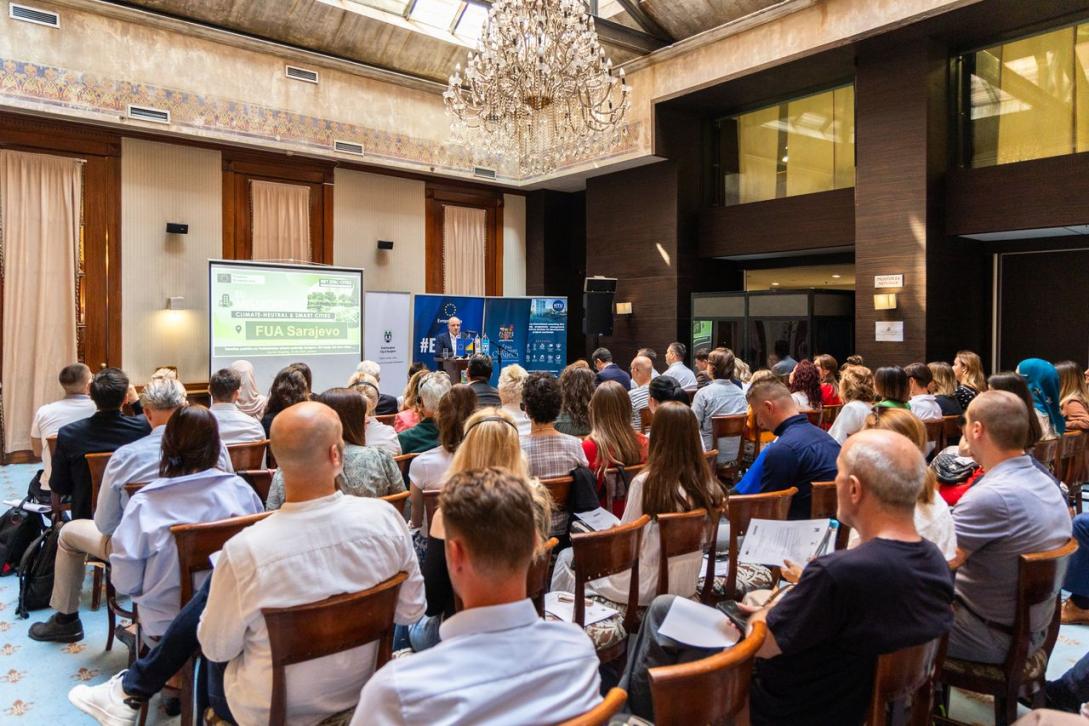
I. Genesis – City/Region Scale: Sarajevo Climate Citizen Assembly 2025
The Sarajevo Climate Citizen Assembly is a pioneering step toward participatory climate governance in Bosnia and Herzegovina and the broader Western Balkans region. Started in 2024 and realized in May 2025, the Assembly was organized by the City of Sarajevo’s Department for Sustainable Development, with support from the European Union Mission for 100 Climate-Neutral and Smart Cities by 2030 (NetZeroCities). The goal was to engage citizens directly in shaping the draft of Sarajevo’s Climate City Contract (CCC) – a strategic document that outlines the roadmap of Sarajevo toward climate neutrality, resilience, and sustainability by 2030.
The initiative emerged from Sarajevo’s growing recognition that achieving climate neutrality requires deep social inclusion and behavioural transformation, not just technical solutions. The Assembly was designed to create a space where citizens could deliberate, propose priorities, and co-develop commitments that will guide the forthcoming Climate City Contract. The event built on a long trajectory of Sarajevo’s participation in European sustainability initiatives, including projects under UNDP, GIZ, and the New European Bauhaus, and reflects the city’s ambition to bridge European policy frameworks with local democratic participation.
The origins of the Assembly can also be traced to Sarajevo’s strategic decision to join the EU Mission Cities Network, which invited member cities to produce Climate City Contracts as a prerequisite for obtaining the NetZeroCities label – a certification granting access to significant funding, expertise, and innovation partnerships across Europe. Within this framework, Sarajevo positioned the citizen assembly both as a deliberative event, and as a new institutional mechanism for ongoing civic involvement in environmental policy-making.
The initiative was also inspired by international models of climate assemblies, such as those in Paris, Warsaw, and Glasgow, while being carefully adapted to the post-conflict, decentralized governance context of Bosnia and Herzegovina. By combining European deliberative democracy methodologies with local traditions of neighbourhood councils and community discussions (“mjesne zajednice”), Sarajevo’s approach represented an innovative fusion of civic engagement and urban governance.
From its conception, the Assembly reflected the city’s broader vision: to democratize climate policy, make sustainability a shared community value, and ensure that the Climate City Contract reflects the situations that its citizens live in. Through this, Sarajevo aims to strengthen social cohesion, enhance trust in public institutions, and affirm its role as a regional leader in participatory urban transformation.
II. Triggers – City/Region Scale: Sarajevo Climate Citizen Assembly 2025
Sarajevo’s decision to start a Climate Citizen Assembly was triggered by a combination of environmental, infrastructural, and socio-political challenges that have increasingly defined the city’s urban day to day. As one of Europe’s most polluted capitals during winter months, Sarajevo faces a complex combination of issues – from outdated heating systems and heavy reliance on fossil fuels, to inefficient public transport, traffic congestion, and the spatial constraints of a city lying within a valley, surrounded by tall mountains. These environmental pressures are further worsened by social inequalities and limited opportunities for citizen participation in decision-making, which have historically undermined trust in institutions and slowed the adoption of climate-related reforms.
Environmental and Climate Challenges
Air pollution remains Sarajevo’s most pressing environmental issue. During heating seasons, fine particulate matter (PM2.5 and PM10) levels often exceed safe limits set by the World Health Organization. This is largely driven by residential combustion of coal and wood, aging vehicle fleets, and limited use of renewable energy. Climate change makes these conditions worse through increased temperature inversions, extended droughts, and more frequent heatwaves. These phenomena not only degrade air quality but also strain public health, particularly among vulnerable populations such as children, the elderly, and low-income households.
The city is also highly vulnerable to natural disasters, notably flash floods and landslides, as witnessed during the catastrophic events of 2014 and subsequent years. Urban expansion into hillside zones, combined with insufficient drainage and deforestation, increases disaster risk. At the same time, the urban core suffers from a lack of green infrastructure capable of absorbing stormwater or mitigating heat island effects. Addressing these climate-related hazards requires coordinated urban planning and participatory risk governance – both central themes of the Assembly’s discussions.
Infrastructure and Energy Inefficiency
Sarajevo’s energy infrastructure is among the least efficient in the region. A majority of buildings rely on obsolete heating systems, with district heating networks operating at low efficiency and limited coverage. The dominance of private vehicles has led to continuous congestion and elevated emissions, while non-motorized mobility remains underdeveloped. Public transport infrastructure, though improving through international investment, still lacks integration with sustainable mobility strategies. These infrastructural problems significantly slow down the city’s transition toward carbon neutrality.
Waste management and circular economy systems also remain underdeveloped, with limited waste separation and recycling capacities. This contributes to land degradation, methane emissions, and resource inefficiency. The need for systemic change in these sectors was identified as one of the main policy areas where citizen input could generate new priorities and consensus.
Socio-political and Institutional Triggers
Beyond environmental damage, the Assembly was motivated by a growing understanding that technocratic climate strategies alone cannot ensure legitimacy or change in behaviour. Fragmented government structures in Bosnia and Herzegovina, divided between multiple administrative levels, often make coordinated climate action difficult. This institutional fragmentation has historically led to implementation gaps in environmental policy. So, the City of Sarajevo sought to introduce an innovative participatory mechanism to bridge the gap between local government, experts, and citizens – ensuring that policy decisions are informed by lived experience.
The Climate Citizen Assembly was started as a response to these systemic challenges: a way to build citizen trust, democratize knowledge, and activate social ownership over the city’s climate transition. It recognized that the success of the forthcoming Climate City Contract depends not only on technical measures but also on public endorsement and citizen co-creation.
Transboundary and Regional Dimension
Although Sarajevo’s challenges are local, their impacts are transboundary in nature. Air pollution and river basin management issues affect surrounding municipalities, requiring coordinated regional approaches. The Assembly therefore also served as a platform to explore inter-municipal and cross-sectoral cooperation, particularly within the context of the EU Mission for 100 Climate-Neutral Cities and the Western Balkans Green Agenda. It marked Sarajevo’s intent to align local climate action with European and regional frameworks, positioning citizen participation as the cornerstone of environmental security and resilience.
III. Transformational Context – City/Region Scale: Sarajevo Climate Citizen Assembly 2025
Recognizing that Sarajevo’s climate challenges could not be solved solely through top-down governance, the City of Sarajevo, City of East Sarajevo, and Canton Sarajevo initiated a new participatory framework aimed at embedding citizen voices directly into the city’s environmental decision-making. The Climate Citizen Assembly, held in May 2025, was designed as both a symbolic and practical step toward co-creating Sarajevo Functional Urban Area’s Climate City Contract (CCC) – the strategic document required for the SFUA’s acceptance to the EU Mission for 100 Climate-Neutral and Smart Cities by 2030.
Rethinking the Approach to Urban Climate Governance
The transformational change started with the SFUA’s decision to move from consultation to deliberation – establishing a structured, inclusive dialogue between citizens, policymakers, experts, and civic organizations. This approach was tailored to Sarajevo’s specific governance reality: a city operating within a fragmented institutional structure and facing deeply rooted socio-economic differences. Because of that, the Assembly was conceptualized not only as a policy tool, but as a democratic innovation in the post-conflict Western Balkans context.
The underlying idea was that meaningful transformation requires both institutional legitimacy and social legitimacy. While the Climate City Contract would define measurable targets for decarbonization, resilience, and energy transition, its long-term success depended on public understanding, acceptance, and ownership. Therefore, the city looked to “translate” climate policy into the language of everyday life – inviting citizens to articulate priorities in areas such as clean air, public transport, green jobs, and access to green spaces.
Institutional Collaboration and Knowledge Partnerships
The Assembly was prepared through a multi-institutional coordination process led by the Design Team consisting of representatives of City of Sarajevo, City of East Sarajevo, and Canton Sarajevo, in collaboration with the NetZeroCities Consortium, the European Commission’s Mission Platform, and the Faculty of Architecture of the University of Sarajevo. The process included preparatory workshops, citizen selection mechanisms, and expert consultations to ensure that the deliberative sessions were both inclusive and evidence-based.
Citizen recruitment followed a civic lottery model, ensuring transparency and demographic balance. Exactly 4,000 invitation letters were mailed to households across all local communities of the Sarajevo FUA. From the respondents, 75 citizens were randomly selected using specialized software to mirror the city’s demographic diversity by age, gender, employment, and residence-including East Sarajevo and Canton Sarajevo. They served as the Assembly’s deliberative core.
.
Learning from Past Limitations
Before the establishment of the Assembly, previous city-level strategies and environmental plans often struggled with limited citizen engagement and inter-departmental coordination. The administrative levels in SFUA recognized that these structural limitations slowed down effective implementation and public participation. The Assembly was then conceived as a corrective mechanism – a way to synchronize local knowledge with technical expertise, and to create a unified climate vision across administrative layers and communities.
In doing so, the process aimed to show that climate action cannot be an isolated environmental issue, but it has to be a comprehensive social program linking the health of the city, economic opportunity, and environmental justice. It positioned climate policy as a shared citizen responsibility -a change in narrative that was central to the ambitions of the Assembly.
Alternative Approaches and Future-oriented Thinking
During the design phase, the city explored multiple models for civic participation, including open consultations, surveys, and town-hall forums. Ultimately, the deliberative assembly model was chosen because it encourages collective reasoning rather than individual opinion-giving, and it can produce coherent policy recommendations that are both informed and legitimate. The city also decided to embed the Assembly process within its institutional structure, envisioning it as a recurring mechanism to accompany updates of the Climate City Contract and future environmental strategies.
By creating this new participatory framework, Sarajevo established an adaptive and experimental policy space that values citizen expertise and connects local priorities with European-level ambitions. This transformational shift from policy-making for citizens to policy-making with citizens marks one of the most significant governance innovations in Sarajevo’s contemporary urban development.
IV. Action Journey – City/Region Scale: Sarajevo Climate Citizen Assembly 2025
At the heart of Sarajevo’s Climate Citizen Assembly is a multi-layered participatory process that redefined how environmental governance operates in the city. The Assembly was structured to combine deliberative democracy, data-driven policy design, and digital innovation – transforming citizens from passive observers of climate policy into co-authors of the city’s climate transition.
Participatory Structure and Methodology
The Climate Citizen Assembly happened during three thematic weekends, through a series of structured deliberation sessions held in May 2025:
- Air quality and clean energy transition
- Sustainable urban mobility and public transport
- Green infrastructure and biodiversity
- Waste reduction and circular economy
Each session began with expert lectures and Knowledge Transfer Modules led by academics, engineers, and urban planners. Facilitated small-group discussions followed, allowing participants to evaluate options, deliberate trade-offs, and formulate recommendations.
Each session combined scientific evidence, participatory mapping, and scenario planning. Citizens were encouraged to think about trade-offs between various actions – for example, expanding district heating networks versus investing in household-level heat-pump systems, or redesigning transport routes to prioritize cycling lanes. This blend of expert guidance and public reasoning produced a realistic and optimistic set of recommendations for Sarajevo’s forthcoming Climate City Contract (CCC).
The process was open and transparent. All sessions were filmed and livestreamed, while summaries, infographics, and presentations were uploaded to the City’s digital channels. This openness strengthened public confidence and invited the broader community to follow and contribute to Sarajevo’s climate debate.
Policies, Regulations, and Actions Undertaken
The Assembly’s outcomes can be grouped into three cross-cutting themes aligned with the OSCE Toolbox classification:
- Peace and Security
- The Assembly fostered environmental peacebuilding by emphasizing cooperation across municipal boundaries and administrative entities (Sarajevo Canton, East Sarajevo, and neighbouring municipalities).
- Participants highlighted the right to a clean environment as a citizen and human security issue, reframing air pollution and energy poverty as social justice concerns.
- The process strengthened public trust and transparency, reducing polarization around environmental decisions and demonstrating how inclusive dialogue can mitigate conflict over scarce resources such as land, water, and air quality.
- Environment and Infrastructure
- Citizens prioritized energy transition measures, including modernization of district heating, expansion of renewable sources, and incentives for home insulation.
- Mobility discussions led to proposals for expanding tram and trolleybus networks, safe cycling infrastructure, and pedestrian zones.
- Participants called for a citywide green network, integrating parks, river corridors, and rooftops as climate-adaptation tools.
- Waste-management reform and circular-economy initiatives were proposed to reduce methane emissions and improve recycling efficiency.
DIGITAL INNOVATIONS?????!
Good Environmental Governance and Institutional Integration
The process demonstrated how participation can move towards becoming a policy. Recommendations emerging from the Assembly were systematically reviewed by the city’s interdepartmental working group and incorporated into the first draft of the Climate City Contract, particularly in the sections on clean energy, mobility, and governance. Moreover, the Assembly’s transparency protocols -publishing of knowledge transfer recording public feedback summaries, and open data – established a new standard of environmental governance in Sarajevo.
The participatory model also influenced broader administrative behaviour: departments dealing with transport, urbanism, and social welfare are interested adopting similar consultative practices. This internal cultural shift may be one of the Assembly’s most lasting legacies.
Social Learning and Trust-Building
Perhaps the most significant transformation was social. For the first time in Sarajevo’s modern governance, citizens deliberated on technical climate measures alongside decision-makers on equal stance. The process built new networks of trust and knowledge exchange, particularly among youth, NGOs, and municipal departments. Citizens expressed a sense of ownership and agency in shaping their city’s green transition, laying the groundwork for continued cooperation beyond the Assembly itself.
V. Future – City/Region Scale: Sarajevo Climate Citizen Assembly 2025
As Sarajevo advances toward its goal of climate neutrality by 2030, the Climate Citizen Assembly has become a foundational mechanism for ensuring that this transition remains inclusive, transparent, and accountable. The process initiated in 2025 is not envisioned as a one-off event, but as the first version of a permanent participatory structure that will accompany the city throughout the drafting, implementation, and periodic review of the Climate City Contract (CCC) and its related action plans.
Institutionalizing Participation and Co-Governance
Building on the positive experience of the furst Assembly, the City of Sarajevo might plan to institutionalize the process by creating a Permanent Citizen Forum for Climate and Sustainability under the Department for Sustainable Development. This body could function as an advisory council to the Mayor and the City Council, composed of citizens, youth representatives, experts, and civil society organizations. Its primary role could be to review progress toward CCC targets, monitor indicators, and propose adjustments in collaboration with the city’s technical departments and European partners.
The Forum could meet annually to deliberate on new challenges, assess policy impacts, and feed citizen perspectives into the NetZeroCities reporting process. This continuous feedback can ensure that the Climate City Contract remains a continuously adapted document – responsive to both scientific developments and social realities.
Integrating Climate Resilience and Disaster Preparedness
In the coming years, Sarajevo aims to deepen the integration of climate adaptation and disaster resilience into its urban governance. The city will prioritize:
- Expanding green and blue infrastructure to mitigate urban heat islands, manage stormwater, and enhance biodiversity.
- Strengthening flood and landslide risk management, particularly in hillside neighborhoods, through community-based early warning systems and resilient landscape design.
- Mainstreaming nature-based solutions in all new infrastructure projects, aligning with EU Green Deal and Horizon Europe priorities.
The Citizen Assembly model can be used to test new participatory tools for risk awareness and collective resilience planning, engaging schools, local communities, and vulnerable groups.
Advancing Environmental Governance and Policy Alignment
Future versions of the Assembly could also focus on improving environmental policy making by strenghtening inter-municipal coordination between Sarajevo, East Sarajevo, Canton Sarajevo and surrounding municipalities in the metropolitan area. This can include shared data systems, joint emission inventories, and regional mobility planning. The city can plan to align these initiatives with the Canton Sarajevo Climate Strategy and the upcoming National Energy and Climate Plan, ensuring policy coherence across administrative levels.
In addition, Sarajevo could aim to introduce green budgeting and participatory monitoring mechanisms to track how local investments contribute to the Climate City Contract objectives. These measures could not only strengthen transparency but also make climate action measurable and accountable.
Empowering the Next Generation
Education and youth engagement should remain central to Sarajevo’s future climate agenda. The city can plan to collaborate with universities and schools to establish Youth Climate Assemblies that mirror the main citizen forum, developing early environmental literacy and civic responsibility. Through these youth-oriented discussions, Sarajevo can aim to cultivate a new generation of informed citizens capable of sustaining the city’s transformation beyond 2030.
Long-Term Vision
In the long term, the Climate Citizen Assembly represents more than a governance experiment – it signals a paradigm shift in how Sarajevo conceives of urban democracy and environmental maintenance. By making deliberation a decision making institution, Sarajevo is building the foundations for a resilient, participatory, and digitally empowered city that can lead by example in the Western Balkans.
The Assembly’s continuation will help Sarajevo achieve not only technical climate neutrality but also a broader social transformation, one grounded in cooperation, innovation, and trust between citizens and institutions.
Annex I -References and Useful Links
Resource | Description / Relevance |
City of Sarajevo -Department for Sustainable Development | Official information and updates on the Climate City Contract and Mission activities. → https://www.sarajevo.ba/en |
NetZeroCities Mission Platform | EU Mission knowledge base and guidance on Climate City Contracts. → https://netzerocities.eu |
Sarajevo Functional Urban Area (Climate Citizens Assembly Portal) | Videos, summaries, and outcomes of the 2025 Assembly. → https://ksgs.ba/ |
NTU International | Technical coordination partner under the NetZeroCities framework. → https://www.ntu.eu |
EU Mission for Climate-Neutral and Smart Cities | Framework context for the Sarajevo CCC process. → https://research-and-innovation.ec.europa.eu |
Annex II Stakeholders
- City of Sarajevo -Department for Sustainable Development (Part of Design Team)
- Canton Sarajevo -Ministry of Spatial Planning, Construction, and Environmental Protection
- City of East Sarajevo -Mayor’s Office
- NTU International (Technical assistance and facilitation framework)
- NetZeroCities Sarajevo Mission Hub (Process integration)
- Facilitation Team -Christiane Amici Raboud (Deliberation lead) and other facilitators
- Citizens of the Sarajevo Functional Urban Area (75 participants selected by civic lottery)
- University of Sarajevo -Faculty of Architecture and Faculty of Mechanical Engineering (Expert contributors)
- Civil society organizations and media partners (Public outreach and communication)